
The Cost of Inaction
The Business Impact of Not Using Professional Services Automation
Many professional services firms look healthy on the surface: growing revenue, winning deals, delivering for clients. But new IDC research shows that organizations that delay or decline the use of a professional services automation (PSA) tool slowly lose efficiency, margin, and predictability over time — falling behind peers who automate.
“
We’re not failing. But we’re working much harder than we should be for the results we’re getting.”

Short-Term Stability, Long-Term Consequences
IDC discovered that organizations operating without a PSA platform could lose between 5 and 10% of potential revenue and productivity due to avoidable inefficiencies. These losses don’t appear as a single breakdown. Instead, they surface through small, compounding gaps that quietly weaken margins, predictability, and control.
Firms without a PSA experienced:
- Up to 20% of time lost to administrative work
- Up to 10% of employee time lost due to misutilization
- 5% margin leakage from unmanaged scope
- 3% delay in invoicing and revenue recognition
- Increased employee fatigue and attrition

Why Erosion Often Goes Unnoticed
One of the most striking findings is that many organizations without PSA continue to grow. IDC notes that among firms that evaluated PSA within the last five years but chose not to adopt, many reported stable or increasing revenue and headcount over the last year.
Yet growth masked deterioration elsewhere. Forecast accuracy, capacity visibility, and financial control often declined even as client satisfaction improved. It’s asymmetrical improvement: progress in delivery paired with weakening operational foundations.
“
Clients are happier, but internally it feels harder every year. That shouldn’t be happening.”

The Erosion Loop
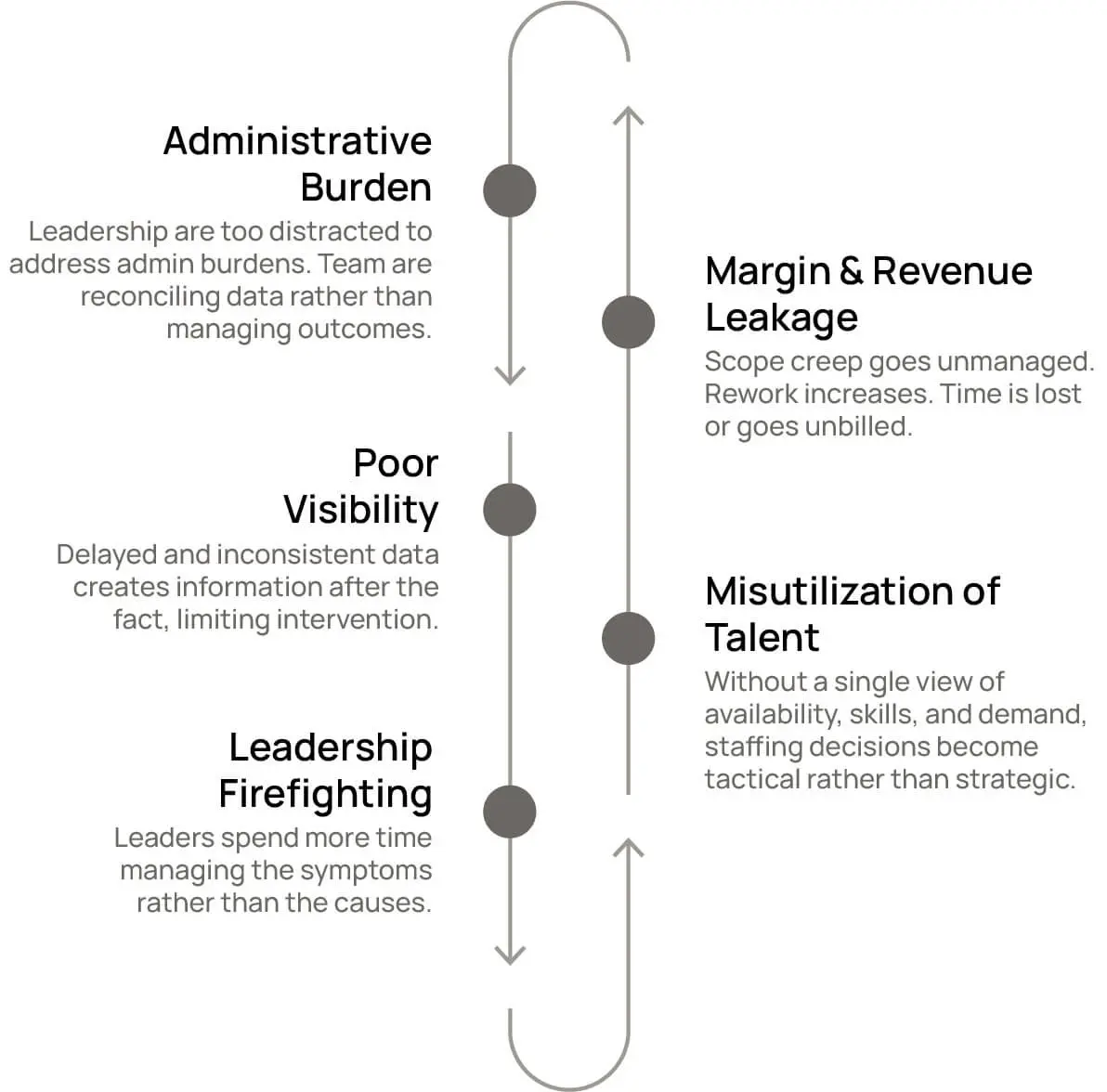
At the heart of the problem is a compounding cycle. Manual processes increase administrative burden, while delayed and inconsistent data limits insights. Poor utilization follows and financial leakage becomes routine.
Disconnected systems create operational drag that steadily weakens forecasting, staffing decisions, and margins. Over time, leaders respond by adding oversight, reports, and approvals — causing costs to rise.
Why “Doing Nothing” is a Decision
Organizations that chose not to adopt PSA did not eliminate inefficiency. They absorbed it. Over time, small gaps in utilization, billing efficiency, and administrative work accumulated into structural value loss.
For many firms, performance looked stable, even as the operating model became more fragile. But IDC’s analysis demonstrates how this erosion adds up across project management, resource utilization, and finance. Effort replaced foresight, control declined, and improvement became harder to sustain.
Doing nothing is not neutral. It is a decision to accept ongoing erosion.
The Strategic Role of PSA
IDC positions PSAs not as productivity tools, but as systems of control. A PSA restores a single source of truth across project delivery, resourcing, and finance. It shifts organizations from reactive management to forward-looking execution.
“We didn’t realize how much value was leaking until we stepped back and looked at the whole system.”
The question IDC leaves organizations with is not whether PSA improves efficiency. The evidence already answers that. The real question is whether professional services organizations can afford the accelerating cost of operating without it.

Explore the IDC Cost of Inaction White Paper
Ready to move beyond manual processes, disconnected tools, and reactive decision-making? Download the IDC Cost of Inaction study for a clear view into what PSAs need to deliver for firms preparing for the future of PS.
Download the Study